Actions to improve the workplace environment
How high can noise levels be and what is the noise limit? Find out what you need to know and get tips on how to reduce noise.
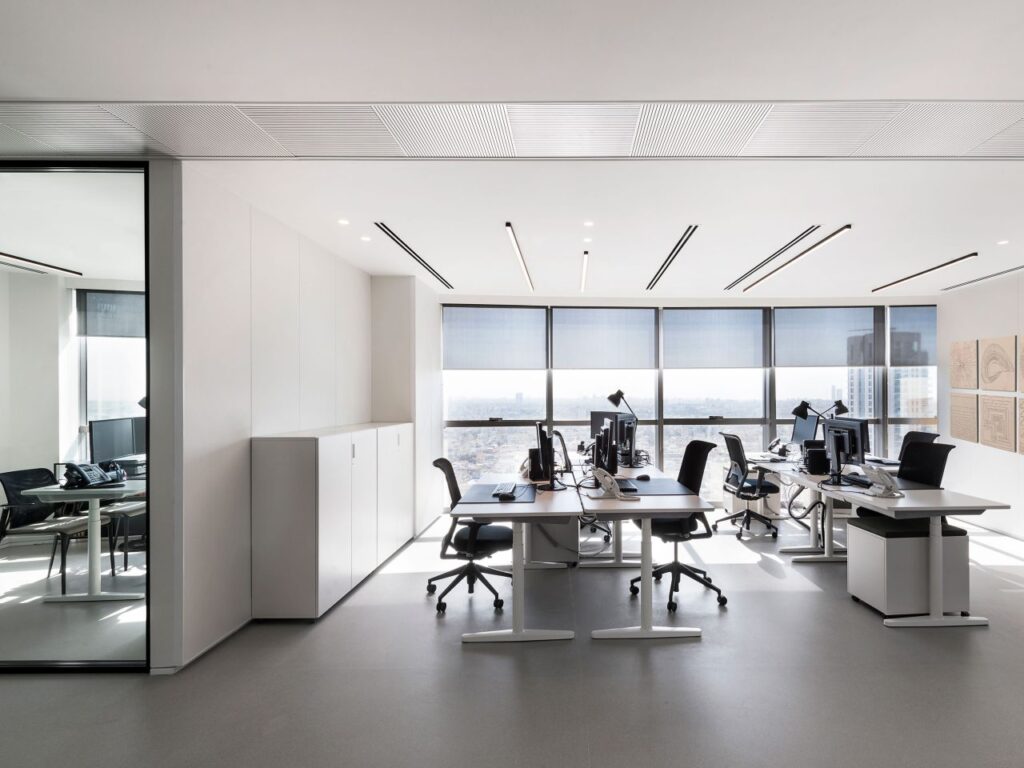
Noise in the office causes stress and has a negative impact on work performance. When an office task requires full concentration, noise can disrupt the flow of work, affect performance and even make people ill in the long term. The intelligibility of conversations suffers from background noise, making communication tiring and error-prone. Good acoustics and noise control in the workplace are essential to ensure a productive and quality working environment for employees.
Noise pollution causes stress
Employees who are stressed by noise are less productive and more likely to fall ill. For those affected, it is important to understand that it is often the noise in the office that causes stress, not the work itself. For the employer, it is all the more important to take proactive measures to prevent noise in the workplace at the planning stage. prevent noise in the workplace at the workplace already in the planning stage.
Individual perception of noise in the workplace
Noise exposure is perceived differently by different people. While one employee may be able to work well in a higher noise level, another may have much more difficulty working in an identical noise environment. Perceived noise exposure is strongly dependent on the activity being performed. Noise is perceived as much more stressful in mentally demanding work than in routine work.
Consequences of too much noise in the officev
- 40 db(A): Up to this level, the conditions for tasks requiring a high level of concentration are perfectly met.
- 45 db(A): Communication with customers and intellectual work can be performed well up to this level.
- 55 db(A): This is the maximum level that should not be exceeded when working at a computer, in an office or in a call center. This is the absolute limit for mental work.
- Volume levels above 55 db(A) are generally perceived by people as serious noise pollution and should therefore be avoided at all costs.
If concentration is impaired by noise in the workplace, errors will creep in and productivity will drop. Especially if the task requires a lot of short-term memory, a lot of calculations or conceptual work, noise will significantly impair work performance. Conversations in the background can impair memory and important information details can be lost, leading to poor performance. The more complex and demanding the task, the more disruptive and detrimental the noise in the workplace is to performance.
The critical sources of noise in the workplace
Colleagues’ conversations and telephone calls are typical sources of human noise in an open-plan office. These noise sources are perceived as stressful because they often lead to involuntary listening. Loud IT equipment such as copiers, printers, plotters or telephones and air conditioning or ventilation systems are possible sources of noise from office equipment or the building’s technical system. Outside noise from business activities or road traffic can also have a detrimental effect. These noise sources are perceived as stressful because they often lead to involuntary listening. Loud IT equipment such as copiers, printers, plotters or telephones and air conditioning or ventilation systems are possible sources of noise from office equipment or the building's technical systems. External noise from business activities or road traffic can also have a detrimental effect.
Sound levels of typical office noise sources
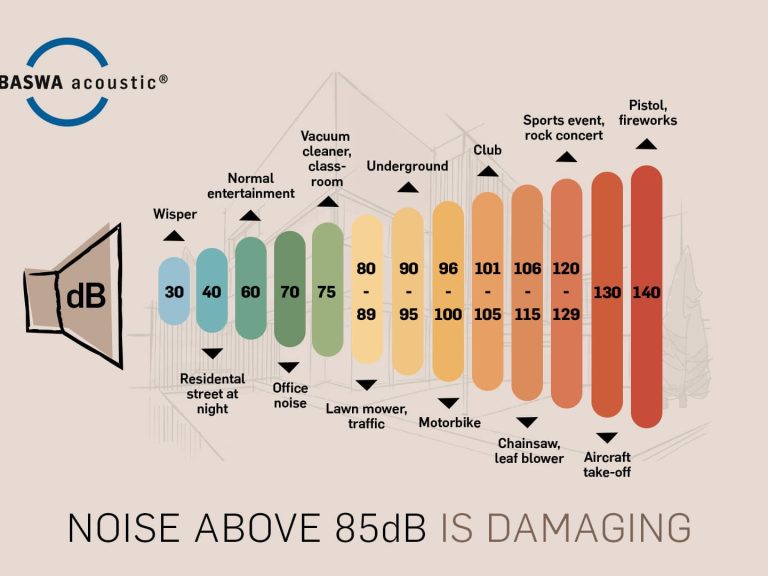
For a better understanding of sound levels, here are some decibel comparisons of typical noise sources:
- 35–45 dB(A) is typical noise from the ventilation system
- 40 dB(A) is quiet radio music
- 50 dB(A) is the sound of a laser printer
- 70 dB(A) is the sound level of loud conversation or an ordinary photocopier.
The acceptable volume in the office
Long-term exposure to noise can also have negative effects on health. Therefore, we cannot and should not get used to office noise. Legislation has been enacted to protect against noise. Institutions that represent the interests of employees publish recommendations and guidelines for maximum permissible noise exposure.
When sound levels are too high
When we are exposed to high sound levels, the main effect is on our hearing. These are known as auditory effects. However, in addition to these aural effects, there are other negative effects, known as extra-aural effects. Extra-aural effects are the body’s reactions to noise. As noise in the workplace is often a continuous exposure, it causes long-term stress reactions in the body and can lead to illness: Noise has a negative effect on hearing and leads to serious overall impairment.
- Impairment of performance, as concentration is reduced, distracted attention leads to increased error rates and communication is disrupted.
- Physiological effects may include increased levels of stress hormones and constriction of blood vessels.
- Psychological impairment: Anxiety, anger, tension, resignation or nervousness.
- Long-term effects: increased risk of cardiovascular and digestive diseases.
Tips for a quieter office
With the right office furniture, you can significantly improve the acoustics in your office. Look for ways to reduce volume, reverberation and echo with the help of office furniture:
- When buying new equipment, look for quiet products. For example, Blue Angel products are particularly quiet.
- Noisy machines such as photocopiers or plotters should be placed in a separate room.
- Paint the walls of the room with surfaces that absorb sound. Special paints or acoustic plaster can significantly improve room acoustics and provide a quality working environment.
- Carpets are sound-absorbing, unlike hard floors with tiles, etc.
- Acoustic partitions, as well as mobile folding partitions, provide good workplace screening.
- Wooden furniture is preferable to furniture with hard surfaces such as glass, steel or ceramics.
A code of conduct to reduce noise in the workplace
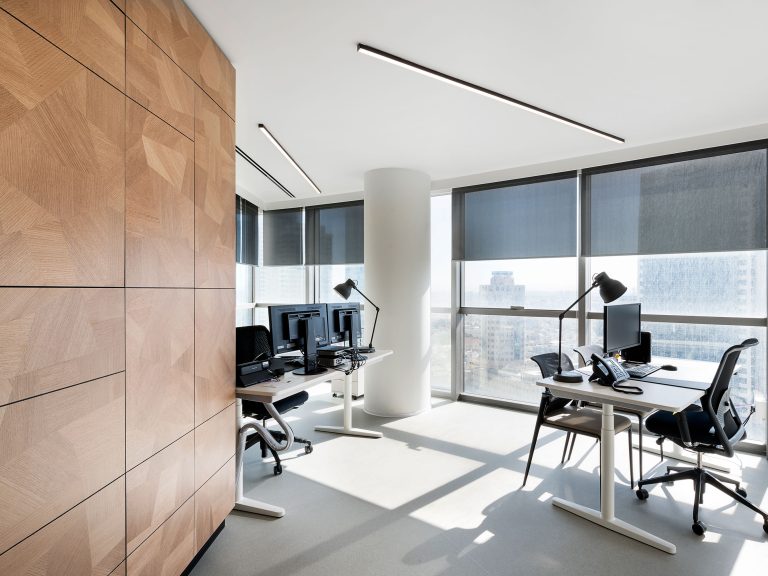
In open-plan offices in particular, in addition to interior design that improves acoustics and the selection of low-noise technical equipment, easy-to-implement measures are useful for reducing noise pollution. These include the spatial organisation of workplaces and rules of behaviour for employees:
- People who communicate frequently and for long periods of time are grouped together in one area of the open-plan office.
- The consistent use of headsets, consisting of headphones and a microphone, significantly reduces noise levels and improves intelligibility for employees on the phone.
- One or more small focus offices should be provided to allow people to concentrate without distraction.
- Quiet periods can be agreed between employees. During this time, there are no conversations or phone calls in the office, which greatly reduces the noise level.
- Agreeing to put mobile phones on silent mode in the office avoids disruptive ringing.
Influence of office furniture on room acoustics
A significant improvement in room acoustics is possible with the right office furniture. Find ways to reduce volume, reverberation and echo with the help of office furniture:
- Felt gliders under all permanent chairs and whisper castors for wheelchairs eliminate annoying background noise.
- Quiet keyboards, mouse pads and cork mats for placing cups or bottles reduce noise in the workplace.
- Sound absorbing curtains in front of wall elements in corner areas or between windows can be helpful.
- Acoustic panels mounted on the ceiling or wall are made of sound-absorbing materials. In large rooms, acoustic panels should be mounted on the ceiling. Seamless acoustic ceilings (consisting of acoustic panels coated with an acoustic plaster), for example, even blend invisibly into the existing architecture. In this way, the acoustic measures are not even visually noticeable.
- Acoustic partitions can be used as pin boards, for example, and can be moved around as required. Sound-absorbing partitions provide both privacy and acoustic screening
- Acoustic columns can help improve acoustics when placed in the corners of a room.
- Acoustic pictures serve as design elements and also have a sound-absorbing effect.
Office noise limits: differences between countries
The requirements and recommendations differ in detail between, for example, Germany, Switzerland and Austria. It is the employer’s responsibility to take appropriate measures to reduce noise exposure in the office so that the specified limits are not exceeded.
The guideline values given below indicate, on the one hand, the volume that should not be continuously exceeded by background noise. Background noise is defined as all noise from built-in technical equipment as well as noise immissions from outside, such as operating noise. In practice, it is also important to take into account noise sources such as computer equipment and human noise. It is always possible to exceed the noise exposure limit for a short period of time. For example: A normal conversation at a distance of 1 m has a sound level of about 60 dB(A).
Taking noise protection in the office a step further: The special benefits of BASWA products
When selecting products, it is not only the sound absorption aspect that is important: the product should also be flame retardant or have flame retardant properties to meet fire safety requirements. The materials should be suitable for allergy sufferers and, finally, the ecological safety of the materials is not insignificant. BASWA’s acoustic solutions meet all these requirements and have even more advantages.
Class A sound absorption
Thanks to its microporous surface, BASWA’s marble sand acoustic plaster achieves excellent Class A sound absorption values. At the same time, our acoustic systems are made from natural materials. Up to 94% of them are recycled. The new plant-based BASWA Natural product line is becoming increasingly important: the acoustic solution made from regional hemp fibres is sustainable and combines efficient sound absorption with a healthy indoor climate.
The seamless acoustic solutions (acoustic ceiling and acoustic wall) from BASWA also offer almost unlimited possibilities for individual design. Depending on the desired look, acoustic ceilings and walls can be smooth, curved and coloured, or with structured surfaces and an exposed concrete look. BASWA acoustic systems are always discreet and fit seamlessly into the architectural and design concept. In addition to the acoustic design of ceilings and walls, our solutions are ideal for the uncompromising and aesthetic design of curves, domes and vaults.
BASWA – efficient sound absorption taken a step further.